

Investigate stock discrepancies
Identify records and biological signals that do not fit together. Prioritise reconciliation before relying on a population estimate.
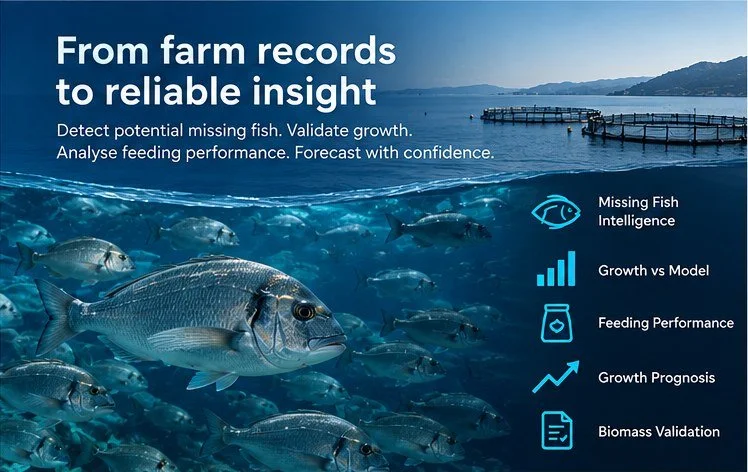
Investigate stock discrepancies, compare production performance and prioritise practical checks using existing farm records.
Check whether fish numbers fit growth, feed and mortality records.
Compare biological FCR, growth and sample weights together.
Prioritise sampling, record reconciliation and reviews of biomass, feed and harvest forecasts.
Start with stocking, dated weights, feed, mortality and movements. No additional underwater counting equipment is required.
PFD estimates discrepancies; it does not directly count fish. Data quality, biological conditions and model suitability matter. Validate findings independently before changing official stock figures. A population estimate does not automatically justify a feed reduction. No achieved savings or independently verified accuracy are claimed here.
See how findings are validated → · Explore PFD →
Tell us your species, production system and question. No subscription commitment or mandatory sales call.
PFD helps farm teams compare recorded fish numbers with growth, feed and mortality information. The aim is a clearer investigation and better-supported planning.
Identify records and biological signals that do not fit together. Prioritise reconciliation before relying on a population estimate.
Compare samples, biological models and FCR. Separate a performance question from a possible recording or sampling problem.
Review assumptions behind biomass, feed requirements and harvest forecasts. Decide where further evidence is needed.
See the growth comparison and validation framework →
Stocking numbers and weights, dated weight samples, feed, mortality and fish movements. Temperature, oxygen, harvests and health events add context. Model suitability must be assessed for your farm. No additional underwater counting equipment is required for record-based analysis.
A potential stock discrepancy is an estimate, not a physical fish count or proof of loss. Data quality, biological conditions and model assumptions affect interpretation. Validate independently before changing official stock figures. A lower fish estimate does not automatically justify a matching feed reduction; financial benefits depend on subsequent decisions.
Tell us your species, production system and question. No subscription commitment or mandatory sales call.
Request a Free One-Cage AnalysisExplore the PFD platform · Install the PFD app · Read the benchmarking guide