
Missing Fish Detection
Detect and quantify hidden stock discrepancies before harvest exposes them.
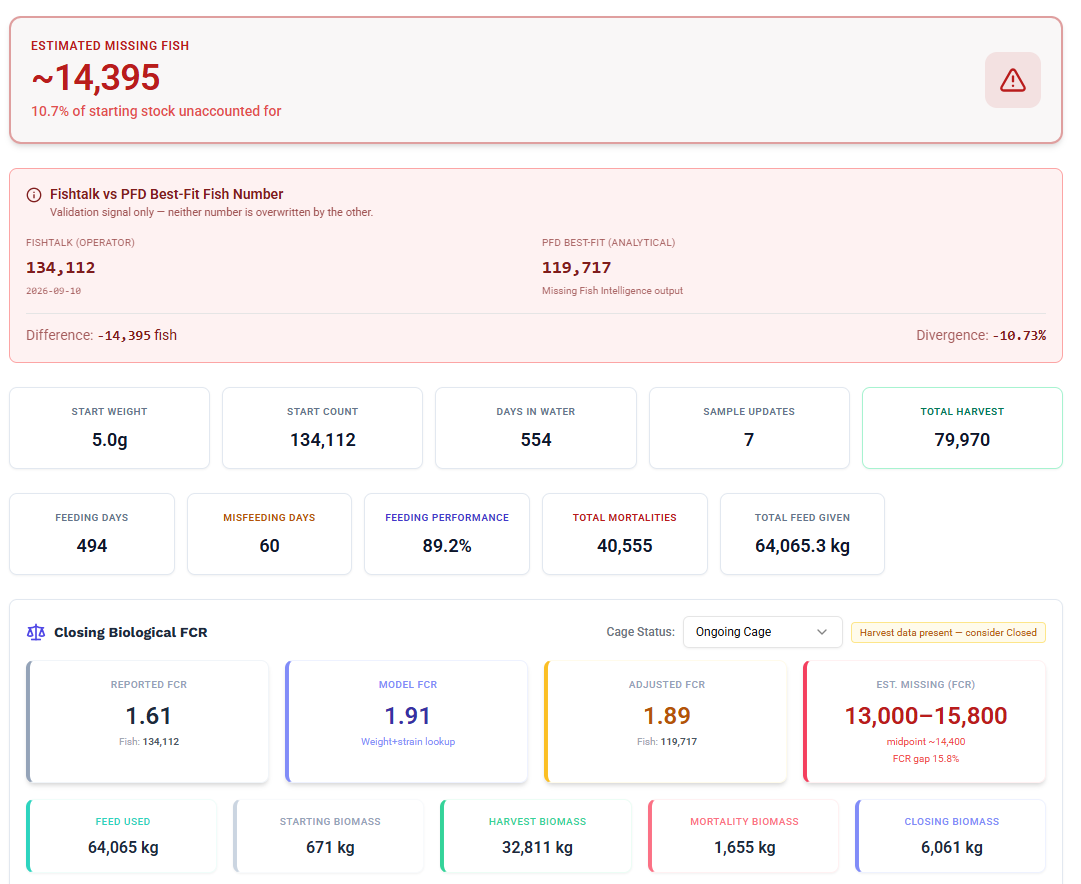
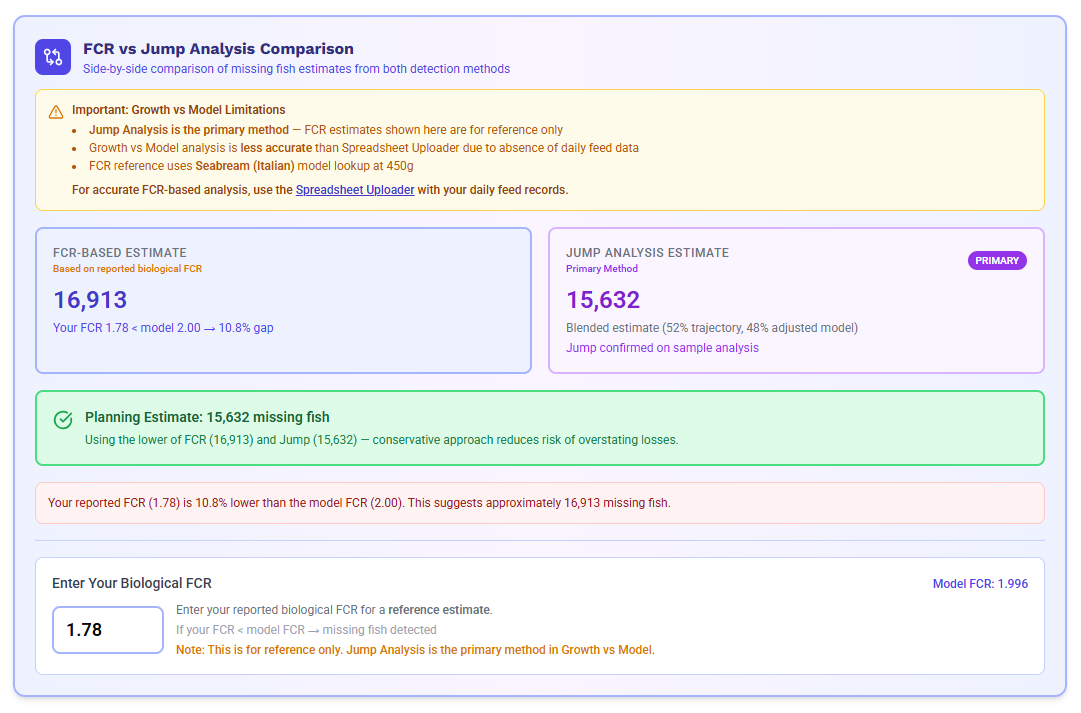
PFD's flagship capability. It evaluates whether production performance is biologically consistent with the declared fish number, and where evidence supports it, estimates a more plausible population. It considers starting stock, mortality, sample weights, growth trajectory, feed delivered, model feed requirement, biological FCR, model FCR, reconstructed biomass, harvest information, stock adjustments and observation-to-observation consistency, then estimates a missing-fish range rather than presenting a single unexplained biomass variance. Why this matters: missing fish are usually discovered at harvest. By then the farm may have spent months feeding fish that were not there, forecasting biomass incorrectly, interpreting FCR against an inflated population and planning harvest tonnage against the wrong number. PFD moves that discovery earlier in the production cycle. Potential explanations — inaccurate hatchery loading, unrecorded mortality, escape, storm damage, predation, handling loss, transfer discrepancy, harvest-recording error — are ranked against the available evidence rather than forced into a single diagnosis.
Additional capabilities
Supporting modules
29 modules
Multi-Signal Biological Reconciliation
Combines fish numbers, feed, growth, FCR, mortality and environment. Strongest conclusions come from convergence between multiple independent signals — never a single metric in isolation.
Snapshot Analysis
Rapid-entry biological reasonableness check for triaging cages before uploading full history.
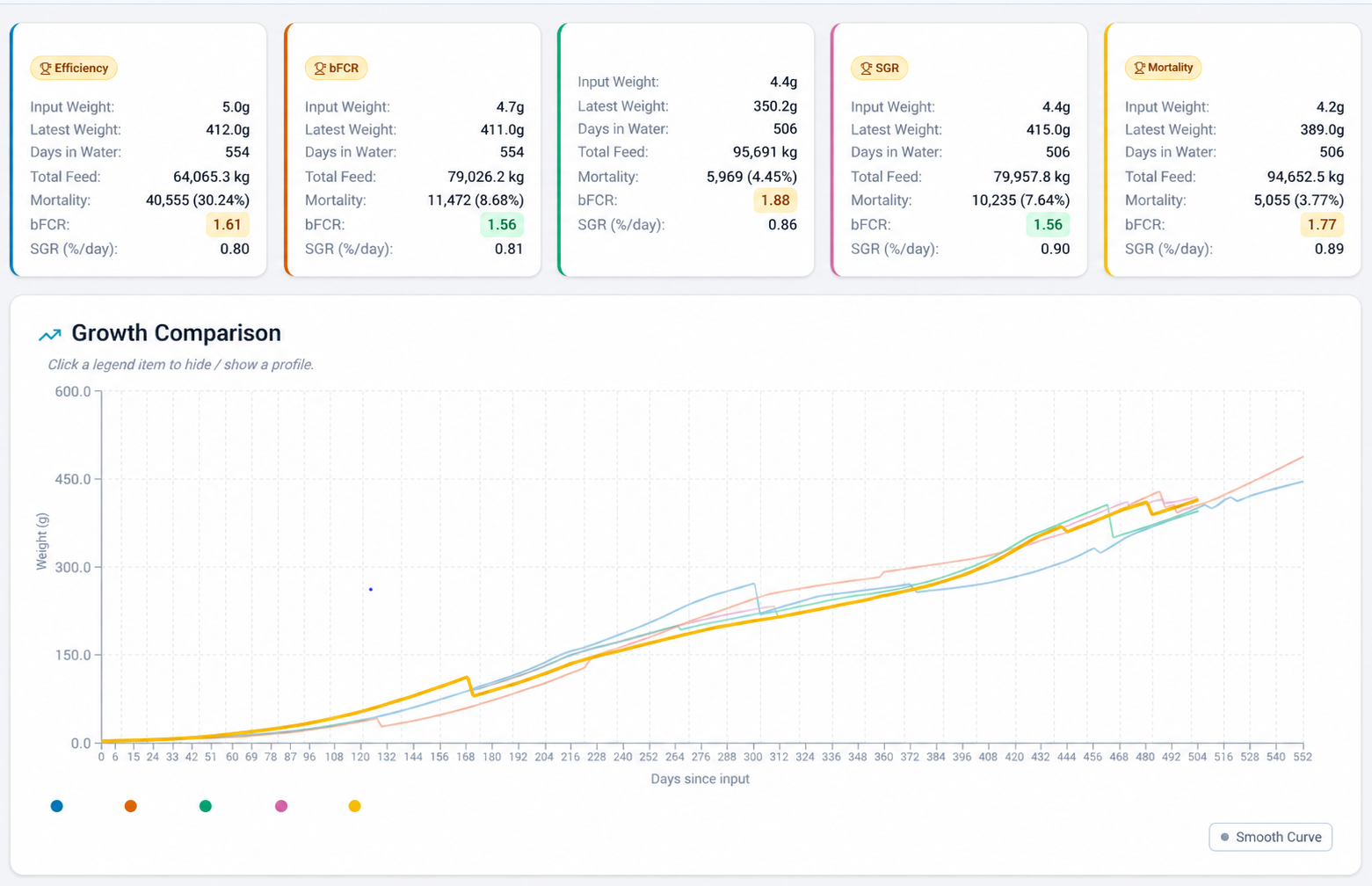
Growth vs Model
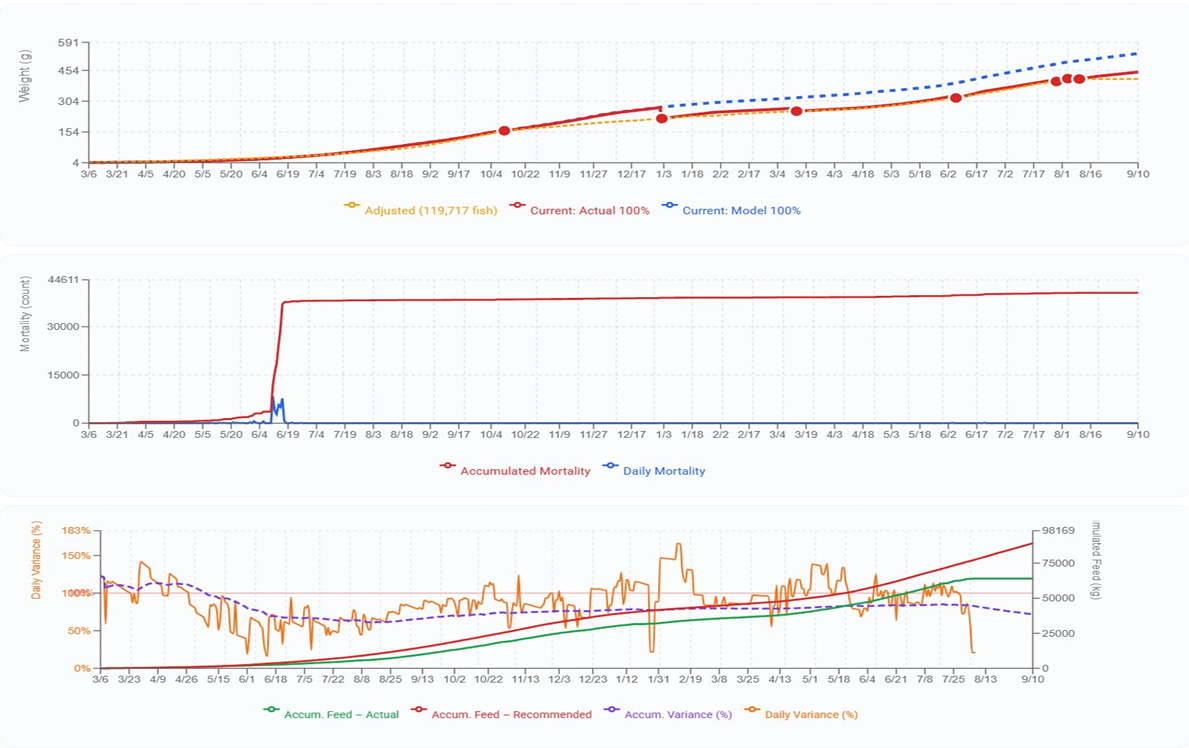
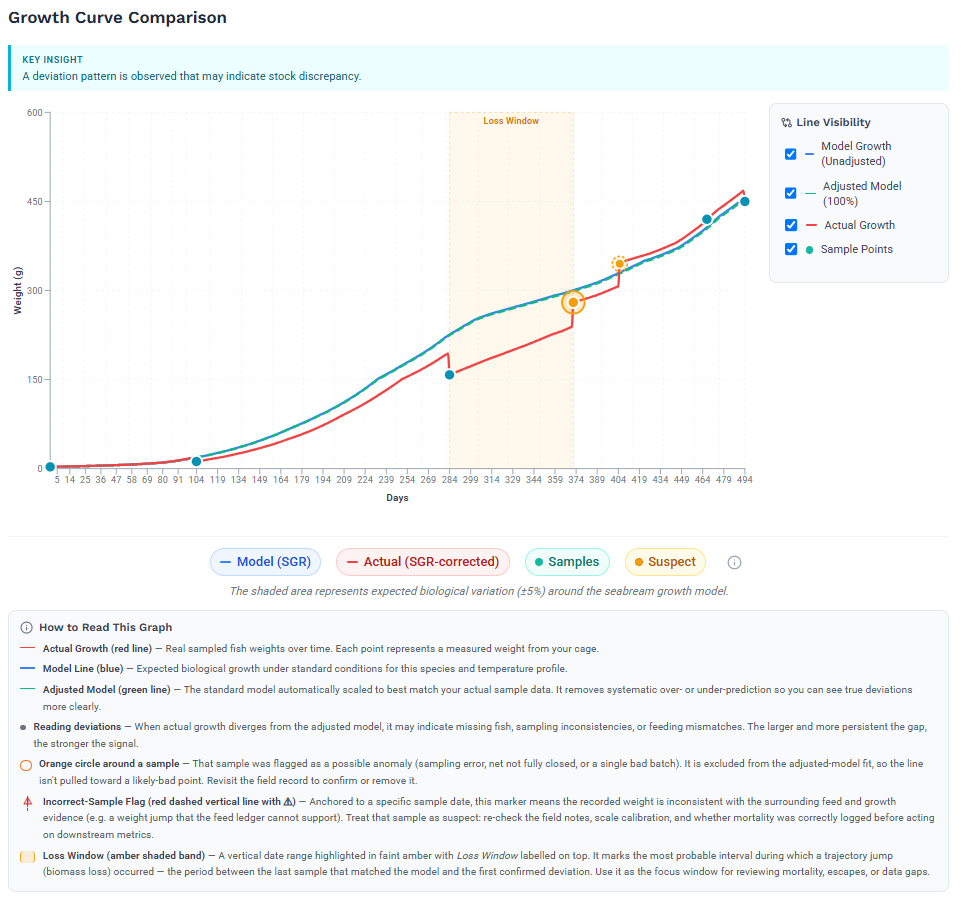
Compares actual growth against expected biological trajectory (direction, magnitude, persistence, timing).
Production Data Uploader
Ingests full production history to reconstruct the cycle: starting/closing biomass, mortality biomass, reported/model/adjusted FCR, and estimated missing fish.
Actual Growth Reconstruction
Reconstructs the likely growth path between physical samples and re-anchors on each new one.
Incorrect / Suspect Sample Detection
Flags samples inconsistent with trajectory, subsequent samples, feed, mortality and harvest.
Loss Window Estimation
Identifies the interval during which a loss developed so it can be compared with storms, transfers, treatments or oxygen events.
FCR Intelligence
Reported biological FCR vs model vs adjusted FCR — interpreted alongside SGR, growth and feeding history.
Relative Feeding Index
Feed delivered vs model expectations, distinguishing daily vs cumulative feeding behaviour.
Misfeeding & No-Feed Day Analysis
Timing of feed restriction matters more than its total volume — juvenile underfeeding costs the whole cycle.
SGR / Growth Performance
Gives SGR equal weight to FCR — fewer production turns is a hidden economic cost.
Temperature-Driven Biological Models
Daily temperature feeds SGR calculations. Regional profiles installed; farms can upload custom thermal models.
Species-Specific Models
Separate biological modelling for sea bream, sea bass and tilapia (user-model architecture supports expansion).
User-Uploaded Biological Models
Farms can move beyond generic industry curves and use their own biological assumptions.
Model Sensitivity Testing
Perturb the growth model to distinguish bad stock numbers from a bad model fit.
Growth Prognosis
Extends corrected biological assumptions forward for harvest timing, biomass and feed requirement.
SFR Calculator
Rapid Specific Feeding Rate calculator for operational feed sizing.
PFD Wingman AI
Explains what appears abnormal, what may explain it, what evidence supports each option and what remains uncertain — without inventing information.
Confidence-Based Decision States
Separates detection from certainty via MONITOR_ONLY / VALIDATION_REQUIRED / ACTIONABLE.
Data Quality Intelligence
Checks for missing feed/mortality/harvest events, duplicates, impossible biomass changes and stale samples.
Merged Population Handling
Handles transferred, combined, partially harvested or topped-up populations with lineage tracking.
Open- and Closed-Cage Analysis
Open cage: what's happening now, what to verify. Closed cage: what actually happened, what to change next cycle.
Harvest Reconciliation
Uses final recovery to validate earlier missing-fish analysis.
Live Cage KPI Overview
Multi-cage triage layer showing biomass, RFI, FCR gaps, missing-fish estimate and sample recency at a glance.
Historical Like-for-Like Benchmarking
Compares against comparable historical cycles (species, hatchery, month, initial weight, site) rather than generic industry norms.
Pre-Harvest Risk Analysis
Increases emphasis on discrepancy signals as cages approach market size.
Summary & Full Reports
Exportable reports for communicating findings to managers, veterinarians and owners.
No New Farm Hardware Required
Core analysis uses production data farms already collect — no cameras, sonar or dedicated cage hardware.
Complements Rather Than Replaces Hardware
Sits alongside biomass cameras, feeders and health-monitoring tools, identifying inconsistencies each system alone can miss.